Free Security Scan
Find your website’s top security risks in 2 business days
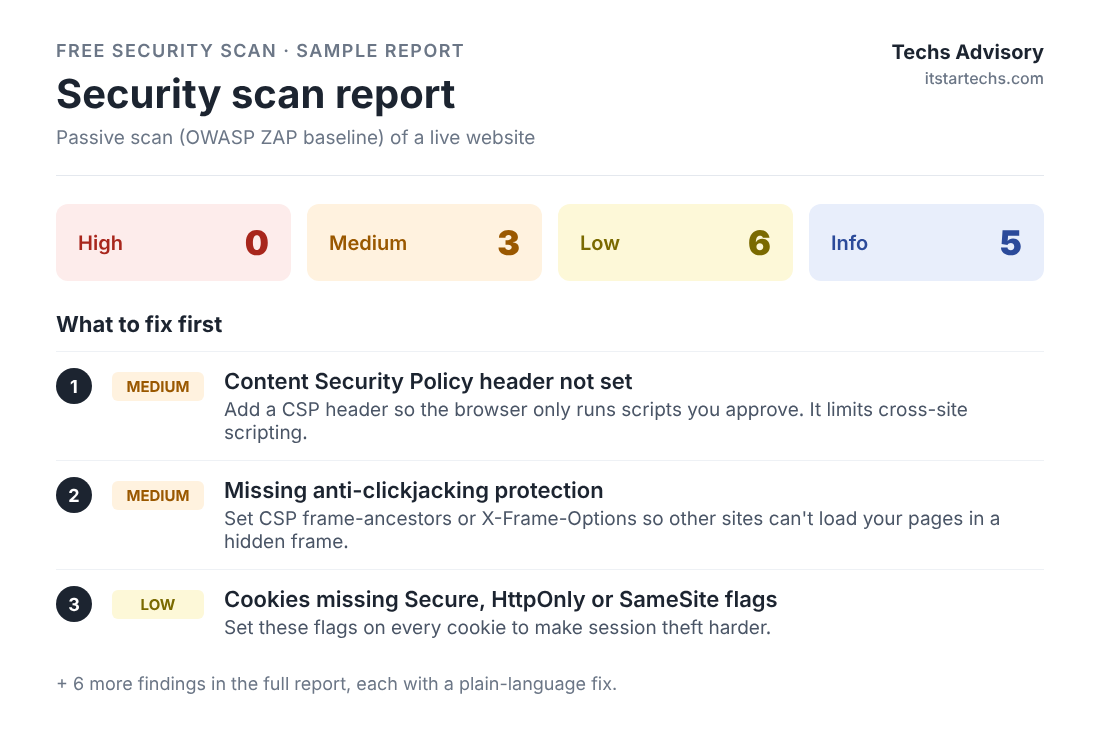
Send us your website URL. We run a passive security scan (OWASP ZAP) and email you a short report: what we found, how serious it is, and what to fix first.
What happens next
-
You send the URL. It takes 30 seconds.
-
Within 2 business days, we scan your public pages. No logins, no attacks.
-
You get the report by email, plus a 20-minute call if you want one.
Prefer to scan your own code? Read our SonarQube SAST guide.

“They don’t just follow our requests. Instead, they share insights in order to improve our ideas.”
The team has recommended changes in our platform’s architecture. So far, they’ve managed to deliver what we’ve agreed upon.
Hang Seng Che, Technical Director, EV Connection
What you get: a short report like this, with what to fix first.
Application Security
Application Security Engineering
Security Architecture is the foundation of application security. While vulnerabilities can often be fixed later, architectural decisions define an application's security posture for years. Choices around trust boundaries, identity, data access, tenancy, and service communication determine how effectively a system can withstand both known and emerging threats.
Strong security architecture embeds security into the design of the system rather than relying on additional controls after implementation. It enables development teams to build secure features consistently, scale with confidence, and reduce the cost and complexity of future security improvements.
Application Security Engineering is the discipline of designing, building, and operating software that remains resilient against security threats throughout its lifecycle. It goes beyond vulnerability scanning by integrating security into software architecture, development, deployment, and operations.
The goal is not only to identify vulnerabilities, but to prevent them through secure design, engineering best practices, and continuous validation across the Software Development Lifecycle (SDLC).
The most effective security improvements happen before the first line of code is written. Security architecture, threat modeling, and secure design decisions eliminate entire classes of vulnerabilities long before they reach production.
Application security is most effective when every layer of the software ecosystem works together as a cohesive whole. Strong security is not achieved through isolated controls or individual tools, but through consistent architectural decisions that connect identity, application logic, data, infrastructure, development practices, and operations. Every component influences the overall security posture, and weaknesses at one layer can undermine protections implemented elsewhere.
Security cohesion ensures that security principles are applied consistently across the entire Software Development Lifecycle, from architecture and implementation to deployment, monitoring, and continuous improvement. Instead of treating security as a final verification step, it becomes an integral part of how software is designed, built, and operated. This approach reduces gaps between teams, technologies, and processes while improving resilience against evolving threats.
A cohesive security strategy aligns architectural patterns, identity models, cloud infrastructure, secure development practices, and operational controls around a common set of principles. The result is a resilient system where each layer reinforces the others, reducing complexity, minimizing attack surfaces, and enabling engineering teams to scale securely without compromising agility.
Our approach to Security Cohesion is built around six complementary disciplines:

Designing secure systems through threat modeling, trust boundaries, secure-by-design principles, and resilient architectures.
Security Architecture
Cloud & Infrastructure Security
Cloud-native security, infrastructure as code, container security, secrets management, networking, and platform hardening.
Identity & Access Management
Authentication, authorization, least privilege, RBAC/ABAC, session management, and secure identity models.
Secure SDLC
Integrating security into planning, development, testing, CI/CD, software supply chain, and release processes.
Application Security
Secure coding practices, OWASP Top 10, API security, input validation, business logic security, and common vulnerability prevention.
Security Operations & Resilience
Logging, monitoring, incident response, auditing, secure configuration, and continuous security validation.